

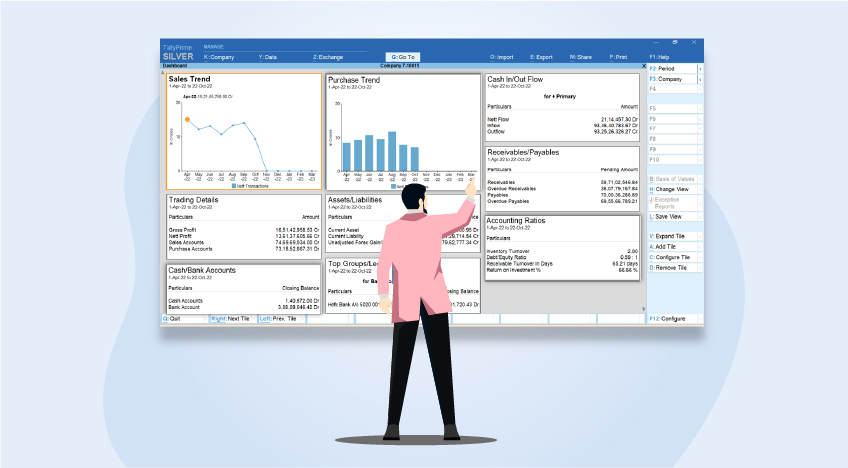
In the contemporary business world, financial insights are critical in decision-making, and must be available on time, precise, and structured. Tally dashboard software offers a practical means of converting raw accounting data into real-time graphics. Such dashboards are clear, facilitate prediction, and improve adherence, and allow businesses to operate with confidence. They make decisions data-driven and strategic by simplifying complex information.
Centralized financial visibility
Tally dashboard tools allow leaders to track cash position, margins, and receivables in one view by aggregating sales, purchases, cash flows, and ledger balances. Rather than creating several manual report runs, finance teams are presented with summarized trends and can drill down to transactions where required. This integrated look brings down data silos, redundancy among departments, and enhances forecasting accuracy. Executives become more confident in short-term liquidity decisions and realistic targets can be established.
The same dashboards allow operational managers to match daily operations to financial objectives, establishing a common performance language within the organization. Dashboards may consist of configurable widgets, threshold alerts, and comparative views which point out month-on-month changes and suspicious variances. They facilitate compliance audit trails and liberate analysts to concentrate on more valuable interpretation. Scenario modelling assists teams in assessing the effects of prices or payment terms, and allows trade-offs between growth and cash retention. Cross-functional accountability is enhanced by shared dashboards in execution.
Real-time monitoring and alerts
To ensure that issues are not left to spiral out of control, real-time dashboards provide a continuous flow of cash, overdue receivables, inventory turnover, and expense burn rates. Deviations to a pattern of things are flagged with automated alerts, meaning that teams can do follow-ups in real time, instead of doing them at the end of the month. Real-time visibility reduces feedback delays between operations and finance, enhancing responsiveness during peak season or supply outages. Constant monitoring also facilitates tighter working capital control and assists daily decision patterns by procurement and collections teams.
Dashboards minimize the reliance on periodic reconciliation and make corrective action measurable by surfacing live anomalies and exceptions. Mobile access provides responsible parties with context-rich updates and the ability to operate wherever they are, maintaining a momentum of decisions across locations. Role-based links give more context- transaction history, invoice supporting and comments by owners, so decision-making is founded on fact and not the gut. This integration enhances inter-team accountability and auditability.
Performance measurement and KPIs
Dashboards transform the complex ledgers into a limited number of pertinent key performance measures that capture profitability, efficiency, and customer metrics. Managing focused KPIs by choosing and monitoring prevents the management team from being overwhelmed by details and focuses on strategic goal drivers. Benchmarking features allow departments, locations, or time periods to be compared, showing best practices and underperformers. The same KPI definition in all reports means that all parties are assessing performance based on the same metrics and eliminates arguments over numbers and supports quicker agreement on corrective actions.
Trend lines and visual scorecards help to identify ongoing gaps and establish stretch targets more easily. Manual errors are minimized in automated data sourcing and enhance the robustness of forecasts relied on in planning and stakeholder debates. Resource allocation becomes objective and defensible when KPIs are directly related to budgets and operational plans. KPI-driven alerts and drill-down capability establishes feedback loops that speed up continuous improvement within teams and explain ownership responsibilities.
Scenario planning and forecasting
The presence of dashboards with historical trends and built-in transactional data makes short-term predictions and comparison of scenarios more reliable. Baseline and alternative scenarios allow finance teams to model how price changes, payment conditions, or supply disruptions affect each other, explaining trade-offs among revenue, margins, and cash. Dashboards assist decision-makers to consider risks and opportunities based on clear numeric implications, not on intuition, by showing multiple scenarios simultaneously.
This organized comparison reduces deliberation cycles and enables contingency planning of suppliers, staffing, and marketing expenditure. Scenario outputs loop back into operational plans in such a way that purchasing, production, and collections teams re-prioritize proactively. The sensitivity analysis helps emphasize the variables that have the greatest impacts so that they can be mitigated. Budgeting and rolling forecasts integration enables organizations to refresh plans regularly and provide probability-weighted results to stakeholders to enable better governance.
Operational efficiency and automation
Dashboards integrate routine reconciliations, aging analysis, and variance report into an automated process that minimizes manual effort and error. With key metrics automatically sourced and updated, finance staff spend less time putting together spreadsheets, and more time analyzing the output and giving advice to the business. Interconnection with procurement, sales, and inventory systems will simplify exception processing: matching invoices with purchase orders, etc. thus operational bottlenecks are revealed promptly. The automation also standardizes report formats and delivery schedules and makes sure that stakeholders get regular information without making ad hoc requests.
By automating repetitive data activities through the system, teams are free to invest in process enhancements, controls, and analytics that lead to margin expansion and cost containment. Role-based workflows and in-dash approvals can speed up routine approvals with audit trails. Improved access to the timing of payables empowers bargaining capabilities against suppliers, decreasing the risk of late payments. More efficient approvals lead to a decrease in the duration of processing cycles and enhanced relations with suppliers, which facilitates more secure supply chains and discounts.
Compliance and auditability
Dashboards consolidate transactional metadata, approvals, and change histories into views that are easily accessed and facilitate internal and external audit. Role-based access controls will enable users to view only suitable data and will give auditors a clear trace of who accessed or changed the records. Real-time reconciliations and time-stamped snapshots minimize timing and balance controversy, facilitating fair regulatory reporting. Templates of standardized report formats and versioning assist in preserving documentation demanded by tax authorities and other regulators, and drill-down links allow a summary figure to be viewed as a source document in quick verifying mode.
Policy-based alerts alert compliance teams on anomalies or possible control breaches, empowering them to investigate this in real time. Data integrity is maintained by validation rules and secures storage: encryption, backups, access logs. Ongoing observation of the abnormal trends aids in fraud detection and shows proactive governance to the stakeholders and regulators. Dashboards have the ability to produce audit ready evidence packages and role based exports with retention policies, saving time and cost of audit and enhancing transparency in finance and operations at any given time.
Conclusion
These dashboards facilitate organizations in making faster and more precise decisions by consolidating their financial data, allowing the organization to monitor financial data in real-time, and to support scenario planning. Standardized KPIs and automation minimize error reduction and teams can be used to focus on strategic analysis, whereas auditability and role-based controls decrease compliance risk. Together, the capabilities enhance governance, operational implementation and financial sustainability. They are thus critical in making informed leadership.