

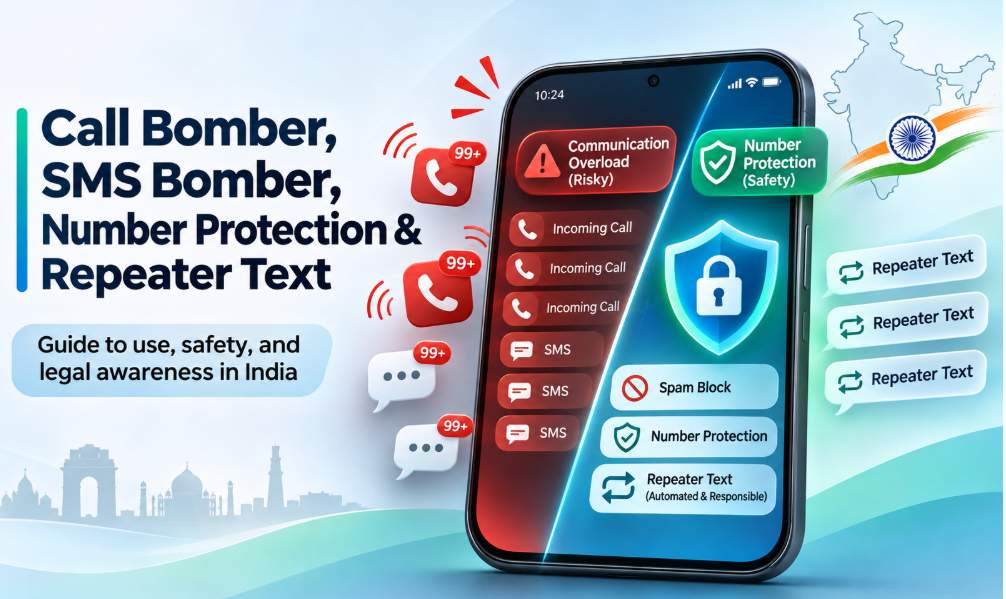
Call Bomber, SMS Bomber, Number Protection, and Repeater Text are different types of online tools that deal with phone calls, text messages, and mobile number safety. Some people search for these tools for entertainment, while others want to repeat text, test messaging systems, send messages to multiple customers, or protect their phone numbers from unwanted calls and SMS.
Although these tools may look similar, they serve different purposes. A text repeater is designed to duplicate text, a bulk SMS service helps businesses communicate with customers, and number protection tools help users manage unwanted calls and messages. Call and SMS bombers, on the other hand, can be misused to overwhelm someone with repeated communication.
In this guide, we will explain how these tools work, what people can use them for, how to protect a mobile number, and which activities are permitted or prohibited under Indian law. We will also discuss safer ways to enjoy text-based tools without disturbing other people.
1. What Is a Call Bomber?
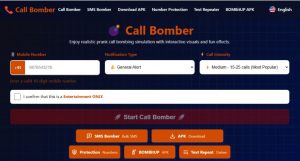
A Call Bomber OR Call Boomer is a type of online tool commonly associated with making Repeated Calls to a particular phone number within a short period. These tools are often advertised as Prank Call or entertainment services, but their actual behaviour can create serious problems for the person receiving the calls.
Imagine receiving an unexpected call every few seconds while you are working, studying, sleeping, or attending an important meeting. It can become frustrating very quickly. You might also miss an important call because your phone is continuously busy.
This is why it is important to understand the difference between a harmless demonstration and unwanted calling activity.
How Does a Call Bomber Work?
At a general level, call-bombing services attempt to generate multiple call requests directed towards a selected phone number. Depending on the service, the activity may involve automated calling systems or other communication services.
The recipient may experience:
- Repeated incoming calls.
- Frequent interruptions throughout the day.
- Difficulty receiving genuine calls.
- Unnecessary battery consumption.
- Stress and inconvenience.
- Problems managing important communications.
The exact behaviour depends on the service being used.
Can You Use a Call Bomber for Entertainment?
People sometimes describe call bombing as a prank between friends. However, a prank does not automatically become harmless simply because the sender considers it funny.
The person receiving the calls may not have agreed to participate. They could be waiting for an important business call, dealing with an emergency, or using their phone for work.
A safer alternative is to use a simulated call-bombing demonstration that does not connect to real telephone networks or disturb another person’s phone.
If you are testing a legitimate calling system, use a controlled testing environment and numbers belonging to consenting participants. Avoid automated high-volume calling against real third-party numbers.
The main idea: Entertainment should not come at the expense of someone else’s privacy or ability to use their phone.
2. What Is an SMS Bomber?
An SMS Bomber is commonly described as a tool that sends repeated text messages to a particular mobile number.
People may encounter these tools while searching for online prank applications, SMS testing services, or automated messaging software.
However, repeatedly sending messages to someone’s phone without permission can quickly turn into harassment or unwanted communication.
How Does an SMS Bomber Work?
Generally, an SMS-bombing service attempts to generate multiple message requests directed towards a selected number.
Depending on the service, the recipient may receive:
- A large number of incoming SMS messages.
- Repeated notifications.
- Unwanted promotional messages.
- Frequent interruptions.
- Messages that make it difficult to find important conversations.
Some services may also abuse automated verification or notification systems. This can create additional problems for the person receiving the messages.
An important distinction is that not every service offering multiple SMS messages is an SMS bomber. Legitimate bulk messaging platforms also deliver messages to multiple recipients, but they operate under different rules and are designed for authorized communication.
Why Do People Search for SMS Bombers?
There are several reasons people search for this type of tool:
- Entertainment: Some users are curious about automated messaging and prank applications.
- Testing: Developers may want to understand how messaging systems handle repeated requests.
- Learning: Beginners may be interested in understanding automated communication technology.
- Bulk communication: Businesses sometimes search for SMS-related tools because they need to contact many customers.
However, these purposes should not be confused.
For example, sending a customer an order confirmation is completely different from repeatedly sending unwanted messages to their personal phone.
For safe testing, use a private simulation or an authorized testing environment rather than a system that sends unwanted messages to real recipients.
3. What Is Repeater Text?
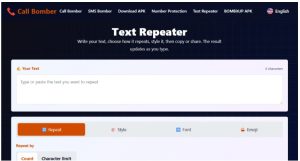
Repeater Text is a simple and useful online utility that allows users to repeat a word, sentence, phrase, or complete paragraph multiple times.
Unlike a call or SMS bomber, a basic text repeater does not need to contact another person or send anything through a mobile network. It simply creates repeated text that users can preview, copy, and use wherever they need it.
For example, suppose you enter:
Input Text: Hello, welcome to our website!
Repeat Count: 5
Your generated result will look like this:
Hello, welcome to our website!
Hello, welcome to our website!
Hello, welcome to our website!
Hello, welcome to our website!
Hello, welcome to our website!
This makes the tool useful for different everyday activities.
What Can You Do With a Repeater Text Tool?
Here are some practical uses:
- Repeat Words and Sentences
Users can repeat a short word, phrase, or sentence as many times as they need for a particular task.
- Create Repeated Text for Social Media
People sometimes need repeated text for creative posts, captions, demonstrations, or formatting experiments.
- Test Website Layouts
Website developers can generate repeated text to check how paragraphs, buttons, text containers, and other page elements behave.
- Create Sample Content
Writers and students can use repeated text when preparing simple examples, mockups, or demonstrations.
- Copy Repeated Text Easily
Instead of manually typing the same sentence again and again, users can generate the required result and copy it with one click.
How to Use Repeater Text
Using a basic text repeater is straightforward.
- Open the Repeater Text tool.
- Enter the word, sentence, or paragraph you want to repeat.
- Select the number of repetitions.
- Choose whether you want a new line or a space between repetitions, if that option is available.
- Generate the repeated text.
- Preview the result.
- Copy the generated text and use it wherever needed.
A good repeater tool should be simple, fast, and easy to use on mobile and desktop devices.
Is Repeater Text the Same as Bulk SMS?
No. These are two different things.
Repeater Text generates repeated content, while a bulk SMS service delivers messages to multiple phone numbers.
For example, a user might generate a repeated sentence using a text repeater and copy it for a personal project. A business, however, would need an authorized messaging platform to send notifications to its customers.
Generating repeated text does not automatically give someone permission to distribute that text to other people.
4. What Is Bulk SMS and How Can You Use It?
Bulk SMS is a communication service that allows individuals, organizations, and businesses to send messages to multiple recipients through an authorized messaging platform.
It is commonly used by businesses that need to share important information with customers.
For example, an online store might send order confirmations, delivery updates, payment notifications, or promotional messages to customers who have agreed to receive them.
Common Uses of Bulk SMS
Business Promotions
Businesses can send information about new products, seasonal offers, discounts, and special campaigns to customers who have provided the required consent.
Order Notifications
E-commerce stores can send updates when an order is received, processed, shipped, or delivered.
Appointment Reminders
Hospitals, clinics, educational institutions, and service providers can send appointment reminders and schedule updates.
Customer Notifications
Companies can communicate important service announcements, account updates, and other relevant information.
Event Updates
Event organizers can share registration confirmations, venue information, and schedule changes.
How to Send Bulk SMS Safely
If you want to send messages to multiple people, use a legitimate SMS gateway or telecom-approved messaging provider.
A responsible process generally involves:
- Choosing an authorized SMS service provider.
- Registering your business or sender where required.
- Obtaining the appropriate customer consent.
- Registering the required sender headers and message templates.
- Checking the recipients’ communication preferences.
- Sending relevant messages through the approved platform.
- Respecting opt-out and consent-revocation requests.
For businesses operating in India, TRAI’s Telecom Commercial Communications Customer Preference Regulations (TCCCPR) establish requirements for commercial messaging.
The current consolidated regulation, released on 9 November 2026, includes requirements relating to registered senders, headers, content templates, consent, and commercial communication. Businesses should check the latest requirements with their telecom provider before launching a campaign.
Official reference: https://www.trai.gov.in/sites/default/files/2026-11/CR_10112026.pdf
Remember: Bulk SMS is a legitimate business communication method when used according to applicable regulations. It should never be treated as permission to send unlimited unwanted messages.
5. Number Protection: How to Protect Your Phone From Call Bombing and SMS Bombing
Your mobile number is connected to many important parts of your daily life, including banking, social media, email, messaging applications, and personal communication.
If someone repeatedly targets your number with unwanted calls or messages, it can become difficult to use your phone normally.
Number protection is therefore an important part of digital safety.
Here are practical steps that can help protect your number.
1. Enable Spam Protection
Many modern smartphones include built-in spam identification and call-filtering features.
Depending on your device, these features can help identify suspected spam callers and reduce unwanted interruptions.
Check your phone’s call settings and enable the available spam protection options.
2. Block Unwanted Numbers
If you repeatedly receive calls from a particular number, consider blocking it.
Most Android and iPhone devices allow users to block individual numbers directly from their call history.
Keep in mind that blocking one number may not stop calls coming from other numbers.
3. Use DND Services in India
India has a system for managing unwanted commercial calls and messages through the Telecom Regulatory Authority of India (TRAI).
Consumers can register their communication preferences through their telecom provider’s available channels, including the 1909 short code.
You can use the available options to restrict unwanted commercial communications and select the categories you are willing to receive.
4. Never Share Your OTP
One of the most important mobile security rules is to never share your OTP with an unknown person.
Someone may use repeated calls or messages to distract you and convince you to share sensitive information.
Remember:
- Never share banking OTPs.
- Never share account recovery codes.
- Never provide passwords to unknown callers.
- Avoid opening suspicious SMS links.
- Do not install applications sent by unknown people.
5. Keep Your Phone Number Private
Avoid publishing your personal mobile number unnecessarily on public websites, unknown discussion groups, or suspicious online platforms.
If you operate a business, consider using a separate business contact number rather than exposing your personal number everywhere.
6. Contact Your Telecom Provider
If you experience a sudden increase in unwanted calls or messages, contact your mobile network operator.
Explain what is happening and ask whether they can provide additional spam filtering, blocking, or account-security assistance.
Keep screenshots and call logs if the problem continues.
7. Report Serious Abuse
If repeated calls or messages involve threats, fraud, impersonation, stalking, or other serious behaviour, preserve the evidence and consider reporting the incident to the appropriate authorities.
India’s National Cyber Crime Reporting Portal is available at:
You should also contact local police when there is an immediate safety concern.
6. Is Call Bombing and SMS Bombing Legal in India?
This is one of the most important questions surrounding these tools.
The legal position depends on how a tool is used, the purpose of the communication, the recipient’s consent, and the impact of the activity.
Simply having a tool or learning about automated messaging does not automatically make someone a criminal.
However, using such tools to harass people, threaten them, misuse telecom resources, or send prohibited commercial communications can create legal consequences.
Let’s understand the difference.
Legal Uses
The following activities can be legitimate when carried out responsibly and in compliance with applicable rules:
- Repeating text using an offline text generator.
- Creating sample messages for educational purposes.
- Testing a messaging application in an authorized development environment.
- Sending permitted bulk SMS through an authorized provider.
- Sending business notifications to customers according to applicable consent and registration requirements.
- Conducting controlled calling tests using consenting participants and an authorized service.
The key factors are authorization, consent, purpose, and compliance.
Illegal or Legally Risky Uses
The following activities can create serious legal problems:
- Repeatedly Disturbing Someone
Sending repeated calls or messages to another person’s number without permission can become harassment, particularly when the purpose is to intimidate, disturb, or interfere with their normal activities.
- Using Someone’s Number Without Authorization
Using another person’s identity or communication resources dishonestly can create additional legal issues.
- Sending Threatening Messages
If messages or calls are used to threaten someone’s safety, reputation, or property, criminal intimidation provisions may apply.
- Misusing Commercial Messaging Services
Sending unsolicited commercial communications outside the applicable TRAI requirements can lead to action against the sender.
- Interfering With Communication Services
Activities intended to disrupt communication services or gain unauthorized access to systems may raise additional legal concerns depending on the conduct involved.
Important Indian Laws and Regulations
TRAI Regulations (TCCCPR)
The Telecom Commercial Communications Customer Preference Regulations, 2018, as amended and consolidated, govern unsolicited commercial communications in India.
The framework requires commercial communications to follow the applicable registration, consent, preference, and sender-identification requirements.
For example, commercial communication must use registered headers or number resources assigned for that purpose. Unregistered senders making commercial communications may face action, including suspension or disconnection of their telecom resources.
Official reference: https://www.trai.gov.in/tcccpr
Information Technology Act, 2000
The Information Technology Act contains provisions dealing with unauthorized computer-related activities, identity theft, and cheating through electronic communication.
Section 66 deals with computer-related offences involving dishonest or fraudulent acts covered by Section 43.
Sections 66C and 66D address identity theft and cheating by personation using computer resources.
However, these provisions do not automatically apply to every repeated call or SMS. The actual conduct and legal requirements must be examined.
Another important point is that Section 66A of the Information Technology Act was struck down by the Supreme Court in 2015 and is omitted from the current Act. It should not be presented as an active offence for sending offensive messages.
Official reference: https://www.indiacode.nic.in/
Bharatiya Nyaya Sanhita (BNS), 2023
The Bharatiya Nyaya Sanhita contains provisions that may become relevant depending on the circumstances.
For example:
- Section 78 addresses stalking, including certain repeated unwanted contact with a woman despite a clear indication of disinterest.
- Section 351 deals with criminal intimidation, including threats intended to cause alarm or force someone to act or refrain from acting.
These provisions have specific legal requirements. Not every unwanted call or SMS automatically constitutes stalking or criminal intimidation.
What Can Happen If Someone Misuses These Tools?
Depending on the circumstances and applicable rules, consequences may include:
- Blocking or restricting communication activity.
- Suspension or disconnection of telecom resources.
- Action against unregistered or non-compliant commercial senders.
- Investigation by the appropriate authorities.
- Criminal proceedings where the facts establish an offence.
- Financial penalties or other legal consequences under applicable provisions.
The important thing to understand is that calling something a prank does not automatically make it legally acceptable.
7. How Can You Safely Use These Tools?
If you are interested in call-related, SMS-related, and text-repetition tools, choose services that clearly explain their functionality and limitations.
A responsible online tool should prioritize user privacy, transparency, and safety.
Here are some features worth looking for.
For a Repeater Text Tool
A good text repeater should offer:
- A simple text input box.
- An adjustable repetition count.
- New-line and space separators.
- A preview of generated text.
- A one-click copy option.
- A clear-text or reset option.
- Mobile-friendly design.
It should also avoid generating unnecessarily huge amounts of text that could slow down a browser.
For a Bulk SMS Tool
A legitimate bulk messaging service should offer:
- Authorized messaging infrastructure.
- Sender registration support.
- Message template management.
- Consent and preference management.
- Delivery reports.
- Appropriate sending limits.
- Opt-out support.
- Secure handling of recipient information.
For Number Protection
A number protection utility should help users understand unwanted communication and take appropriate protective action.
Useful features may include:
- Basic safety information.
- Spam prevention guidance.
- Instructions for blocking numbers.
- DND registration information.
- Reporting guidance.
- Privacy recommendations.
For Call-Bombing Demonstrations
A safer educational demonstration should use simulated calls rather than generating repeated calls to real third-party numbers.
It should not offer anonymous mass calling, number harvesting, telecom-resource abuse, or unrestricted automated calling.
This approach allows people to understand the concept without turning an entertainment feature into a harassment tool.
8. Frequently Asked Questions (FAQs)
What Is the Difference Between a Call Bomber and an SMS Bomber?
A Call Bomber is associated with repeated incoming calls to a selected number, while an SMS Bomber is associated with repeated text messages. Both can be misused to disturb or harass someone.
Is Using a Call Bomber Legal in India?
It depends on the activity and circumstances. Repeatedly calling someone without consent to harass or threaten them can create legal consequences. Commercial calling must also comply with applicable TRAI regulations.
Is an SMS Bomber Safe to Use?
Not necessarily. Some services may expose users to suspicious websites, intrusive advertisements, or unsafe requests for personal information. Sending unwanted messages to other people can also cause legal and privacy problems.
Can I Send Bulk SMS in India?
Yes. Businesses can send bulk SMS through authorized providers while following applicable TRAI registration, sender identification, consent, template, and customer preference requirements.
What Is a Repeater Text Generator?
A Repeater Text Generator is an online utility that duplicates a word, sentence, or paragraph a selected number of times. It is useful for creating sample content, formatting demonstrations, and repeated text.
Can Repeater Text Send Bulk SMS?
No. A basic text repeater only generates repeated content. It does not automatically send messages through a mobile network. To send bulk SMS, you need an appropriate messaging service and must follow applicable regulations.
How Can I Protect My Number From Call Bombing?
Enable available spam protection, block unwanted callers, contact your telecom operator, avoid sharing your number publicly, and preserve call logs if the problem continues. For unwanted commercial communications in India, use the available TRAI complaint and DND channels.
Can I Report Unwanted Calls and Messages in India?
Yes. You can report unwanted commercial communications through your telecom provider’s complaint channels, including 1909, and use the National Cyber Crime Reporting Portal for relevant cybercrime incidents.
Does Repeating Text Harm a Mobile Phone?
A normal text repeater that generates text locally in your browser does not ordinarily harm a phone. However, generating extremely large amounts of text may affect browser performance or consume device memory.
Can I Use These Tools for Educational Purposes?
Yes, educational uses such as understanding automated communication, generating sample text, and testing software in controlled environments can be legitimate. Always use authorized systems and avoid disturbing real users.
Conclusion
Call Bomber, SMS Bomber, Number Protection, and Repeater Text are related to different aspects of digital communication, but they should not be treated as interchangeable tools.
A Repeater Text tool offers a simple way to generate repeated words and sentences. Bulk SMS services help businesses communicate with customers through authorized messaging systems. Number protection features help users manage unwanted calls and messages, while call and SMS bombers are associated with repeated communication that can easily become harmful when misused.
If you want to explore these tools, focus on their legitimate and responsible uses. Choose services that respect privacy, follow Indian telecom regulations, and protect users from unwanted communication.
Technology should make communication easier, not make someone else’s phone impossible to use.