

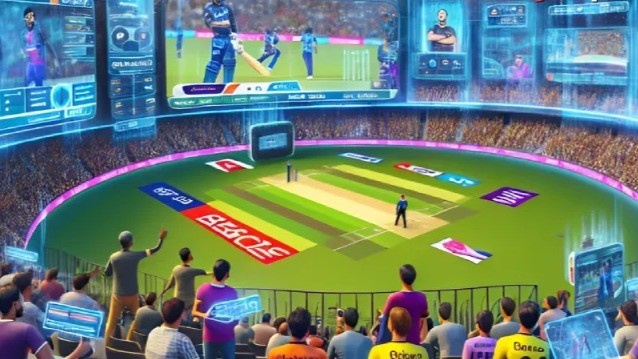
Cricket has quietly become one of the most active testing grounds for sports technology. The volume of data captured in a single match is enormous. Every ball produces measurable inputs: speed, seam movement, bounce height, field placement, shot direction, and reaction time.
This creates the perfect setting for machine learning models that interpret patterns fast enough to influence how fans watch and understand the game.
Over the past three years, cricket boards, broadcasters, and digital platforms have shifted from simply collecting data to building AI-driven systems that package insights for viewers.
The experience for fans is different now. They see projections, probabilities, predictive replays, and context-driven highlights that did not exist a decade ago. AI is no longer a background tool for analysts. It sits directly in front of the audience.
AI in Broadcasts: What Fans See on Screen Every Match
Hawk-Eye entered cricket long before AI became mainstream, but recent upgrades rely heavily on machine learning. Trajectory mapping uses large datasets from thousands of deliveries, which improves bounce prediction and lateral movement accuracy.
Then there’s also UltraEdge, which relies on adaptive noise filtering to remove ambient stadium sound. ICC broadcast guidelines confirm that newer versions of these systems are trained across multiple camera angles to reduce error frequency.
Broadcasters also use AI to generate win probability charts. ESPNcricinfo’s ball-by-ball model updates in real time and is now referenced on nearly every major broadcast. Star Sports added AI-driven field placement replays during the 2023 World Cup that reconstruct how fielders moved during boundary saves.
During the 2023 World Cup, Star Sports head Sanjog Gupta told Reuters that AI allows production teams to “generate personalised highlight cuts within seconds,” which helps broadcasters serve casual fans and deep followers at the same time.
Stadium Experience Powered by AI Systems
Most viewers focus on the broadcast, but IPL venues have been upgrading their tech too. Smart ticketing systems can now flag congestion patterns hours before gates open. AI models also help predict which entry points will get overwhelmed based on past matches and current sales, and security teams now also get to use heat map tools to monitor crowd density.
BCCI’s operations reports mention the use of automated pitch moisture scanners and AI-assisted turf monitoring. Even LED boards around the boundary use real-time scoring and sponsorship algorithms to select which graphics appear after wickets or big overs.
These upgrades help fans experience hassle-free entry, more predictable seating flows, and cleaner match day operations, especially in the largest stadiums.
Predictive Models Entering Mainstream Fan Culture
This is pretty much the area where AI has become part of everyday cricket talk. Fans now expect win predictors, projected strike rates, expected wickets, and momentum charts as a normal feature of odds platforms or even streaming services.
Some platforms publish simplified versions of these models for casual audiences. This is where many fans read sports forecasts for vivid cricket fans, a category that sits between statistical preview and tactical explanation.
Use of AI in Commentary and Journalism
AI has entered the production room, too. Automated match summaries help newsrooms file stories quickly. Several outlets also use machine learning tools to scan for tactical cues such as changes in seam release, bowling speed drop-offs, or shifts in fielder positioning.
The commentators also now receive instant breakdowns through backroom assistants. During the 2024 IPL, analysts have been reported to use AI to point out if a batter showed predictable footwork that bowlers could exploit. This was actually confirmed by the ICC. Tools were tested during major tournaments to help commentators identify matchup-based insights more quickly.
Fans Now Access Team-Level Analytics Once Reserved for Analysts
Public dashboards provide bowling speed clusters, heat maps, fitness load summaries, and fielding efficiency percentages.
Because of those, supporters can easily compare powerplay control rates, death over performance, or matchups between bowlers and specific batters. It’s so different from the whole experience before all this AI tech, as back then, whatever happened on the field was the only thing that mattered because that’s what was only accessible.
Concerns Around Accuracy and Transparency
At this point, we can still say that AI tools are not perfect, and they may never be. Tracking errors still appear in extreme lighting or when multiple players overlap visually. Predictive models occasionally misjudge rare game states.
Then privacy concerns also emerged when app audits revealed extensive behavioural tracking. CERT In advisories highlighted these risks in 2024 and urged developers to limit unnecessary data collection.
Conclusion
We can’t deny that AI now shapes every layer of the cricket fan experience. From the broadcast to the stadium gate to the apps that deliver highlights, machine learning tools guide how fans watch, interpret, and discuss the game.
The trend will only deepen as AR overlays, personalized viewing angles, and automated analysis tools move into mainstream platforms. The bottom line? The sport is evolving in real time, and fans are benefiting from this by receiving more information than ever before.